Which amulets were actually worn by the living?
Most Egyptian amulets come from tombs, but many were first worn in daily life. Two observations help to understand which ones.
- Less than 10% of the hundreds of amulets I have handled have clear signs of extensive wear. However, we know that amulets were carried in precious metal cases, in linen and leather bags, and probably in other protective perishable devices.
- Many more amulets were found in the common burials of women and children than in those of adult men. Women and children were more fragile during pregnancy and growth, and required more magical protection1.
Reference
1 Pinch G. Magic in Ancient Egypt, 2006, The British Museum Press, p. 106
Limited examples
Scarabs
Scarabs are the most common amulets. Scarabs pushing a ball of faeces were assimilated to the daily journey of the sun god Khepri. Female scarabs lay their eggs in the faeces of sheep. The scarab thus became a symbol of spontaneous generation and rebirth. Scarabs mounted on rings were used as seals. There are also scaraboids. Scarab(oid)s spread to all parts of the ancient world, as far as Russia.
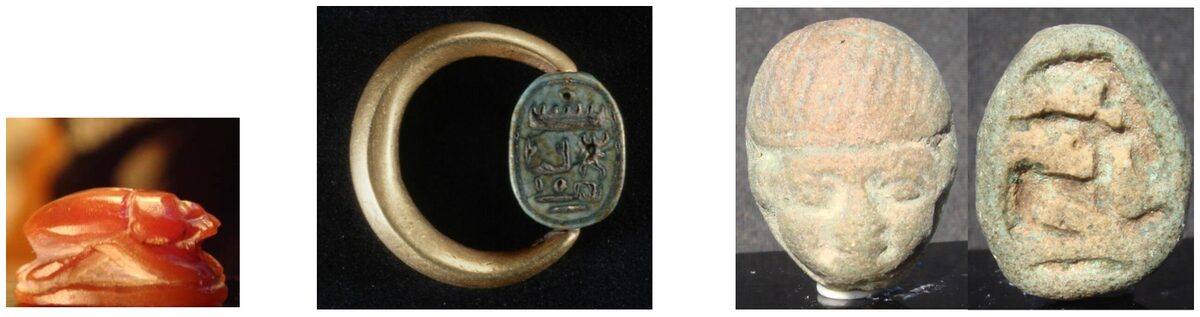
Carnelian god Khepri L 1.0, New Kingdom, Private collection DA; gold ring and enamelled steatite Ø 2.0, Dynasty 18, © 1999 Musée du Louvre/Georges Poncet #E 3246; scaraboid in green glazed steatite with a human head, from Naukratis H 2.1, Late Period, Private collection DA
Wedjat eye
Seth damaged an eye of his nephew Horus in a battle; Horus was taking revenge for his father Osiris, killed by Seth. Next, Horus gave his eye, repaired by Thoth, to Osiris, so that he lived again. Wedjat eyes are the repaired eye of Horus, symbolic of resurrection. They were made in an infinity of materials and variants throughout all dynastic periods.
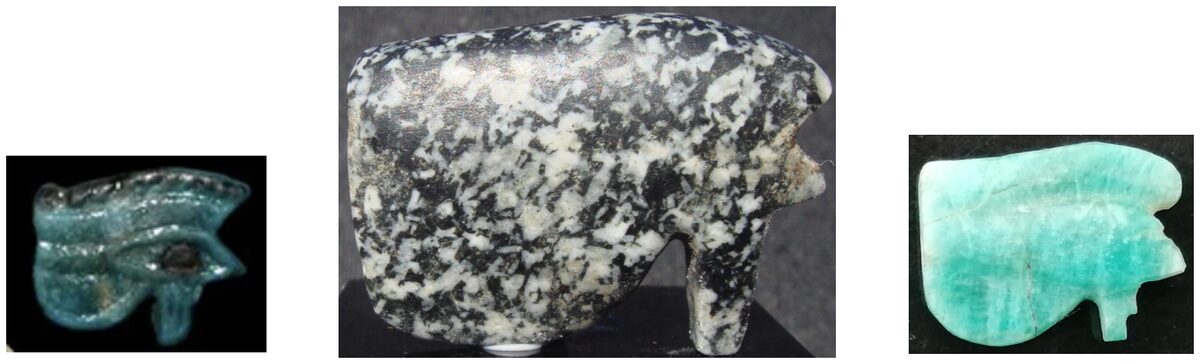
Blue and black glaze flat back L 1.2, Late Period; biconvex diorite L 3.0, Third Intermediate Period, Private collection DA; incised amazonite, flat back L 1.3
God Bes
Bes became very popular in the New Kingdom. He was mainly believed to ensure childbirth in optimal conditions and to protect children.
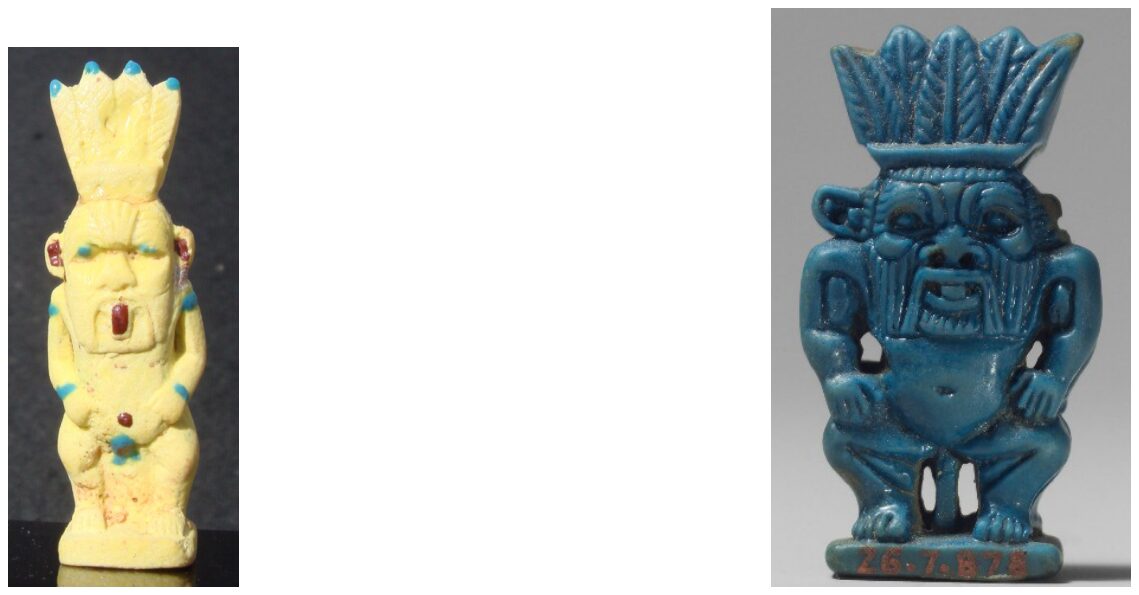
Trichrome glaze H 3.5, Dynasty 18, Amarna Period, Private collection DA; blue glaze H 3.7, Third Intermediate Period, The Metropolitan Museum of Art #26.7.878
Goddess Taweret
The pregnant hippopotamus-headed goddess was the protector of childbirth and lactation.
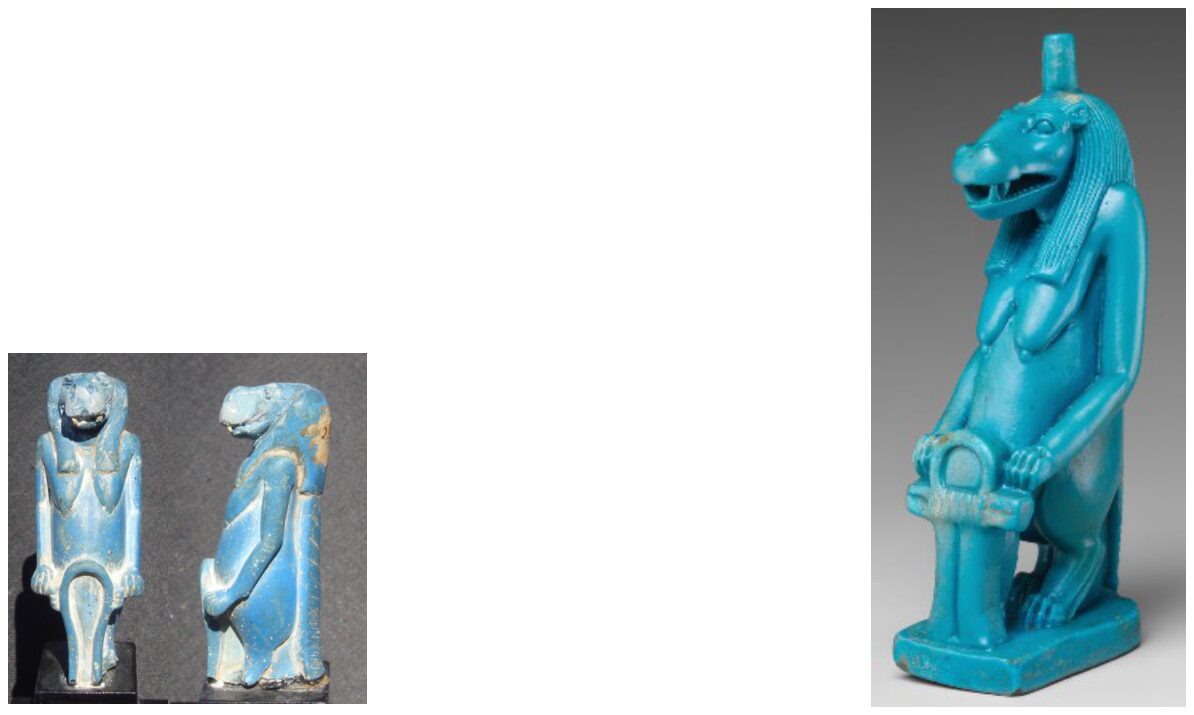
Blue/violet glass H 5.1, Late Dynasty 18 to Dynasty 22-23, Private collection DA; blue glaze H 11.0, Ptolemaic Period, The Metropolitan Museum of Art #26.7.1193
Goddess Nut as a sow
Such amulets were presents given at the New Year celebration for an abundant lactation of mothers.
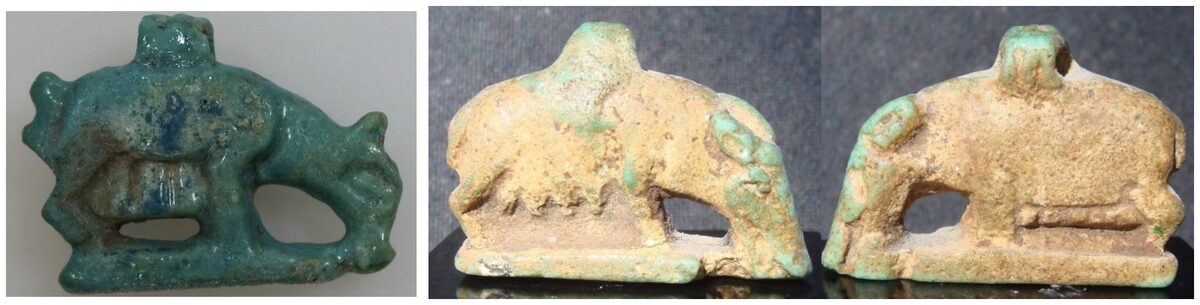
Blue glaze L 2.6, Late Period, © 2018 Musée du Louvre/Antiquités égyptiennes #E 5974; faded green glaze L 2.7, Late Period, Private collection DA. Note the extensive wear (annealed suspension loop fully eroded) and the amazing different triangular and squared udders
Rebirth, fertility and childbirth
Indeed, most of the highly popular amulets worn by the living were reminiscent of rebirth or eternal life, or played a role in fertility (hare, rabbit, frog, cat…), in the prevention of problematic childbirth or in optimal growth, since infant mortality was very high.
In contrast with this observation, and for unknown reasons, some amulets with a closely similar significance are quite rare. This includes ankh amulets (the hieroglyph for life) and amulets of Osiris, the first god who was resurrected.
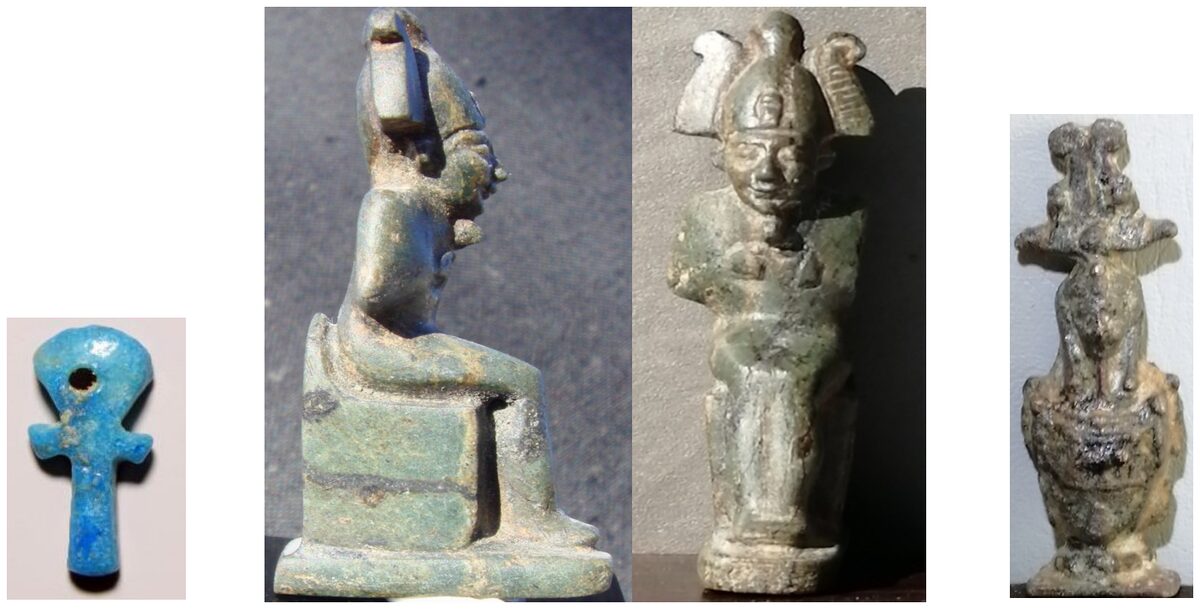
Blue glazed ankh H 1.7, Late Period; greywacke enthroned Osiris with atef crown H 4.2, Late Period, Saite Dynasty 26; copper alloy Canopic Osiris with atef crown H 3.3, Ptolemaic or Roman Period. Private collection DA