Identification and period
Identifying the deity represented by an amulet and dating it are the two main difficulties for collectors and curators. This page reviews the criteria that help: representation, means of suspension, material and colour, quality of production, technique and passing fads. It ends with a chart summarising these criteria by period.
Representation, often tricky for animal and anthropomorphic deities
Carol Andrews pointed out the difficulty of identifying for sure some goddesses and gods who have the same sacred animal:
- Falcon gods can be Horus, Harwer, Sokar or Montu…
- Leonine goddesses can be Sekhmet, Tefnut, Pakhet, or even Bastet, more usually represented with a cat head…
- Ram gods can be Khnum, Amun, Re or Heryshef…
The name of the represented divinity is very rarely indicated under the base, on the dorsal pillar or on a pectoral of an amulet.
Example with the god Thoth
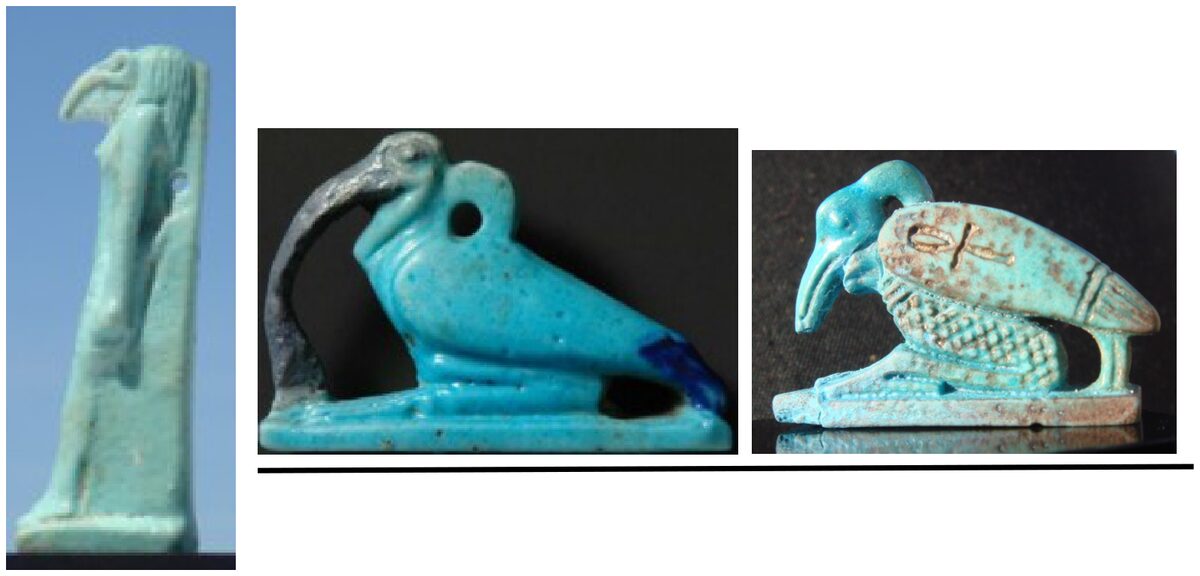
Ibis-headed god Thoth, blue glaze H 4.5, Late Period, Private collection. Thoth as an ibis: trichrome glaze L 4.0, Late Period, © 2022 Musée d’art et d’histoire de Genève #A 2004-0061; blue glaze L 3.3, Third Intermediate Period-Late Period, Private collection DA
Thoth as an ibis or an ibis-headed man refers to the role of this god in the ‘weighing of the heart’ ceremony. He recorded the result of the weighing of the heart of the deceased, balanced against the weight of the feather of Maat.
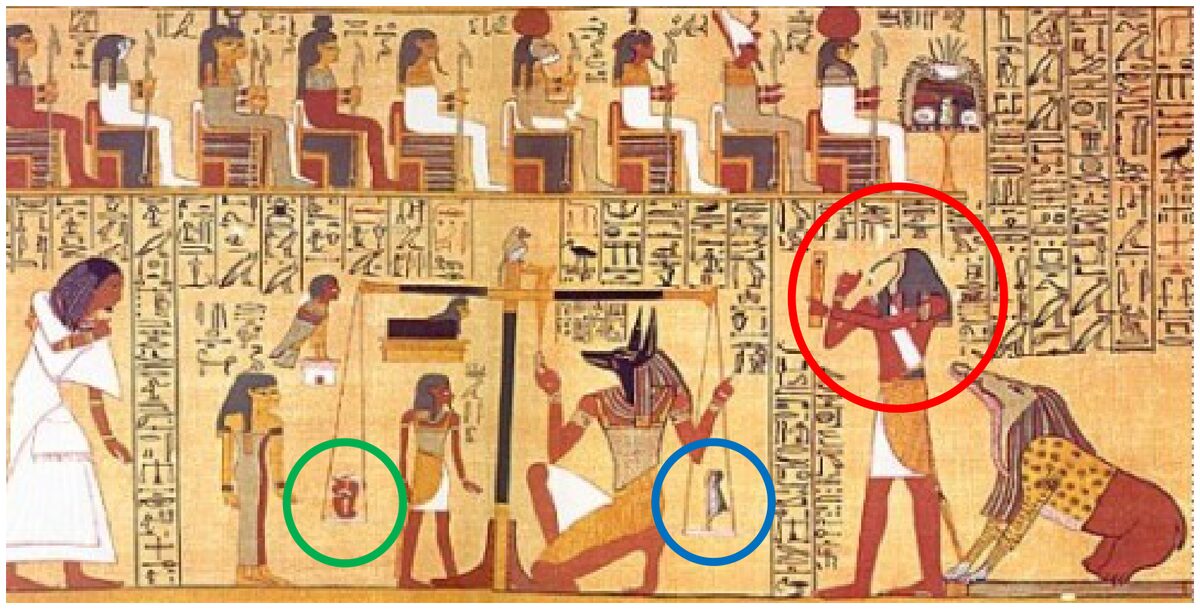
Papyrus of Ani, New Kingdom, Dynasty 19. © The Trustees of the British Museum #EA10470,3
Thoth is a squatting baboon when referring to the god of writing, patron of scribes.
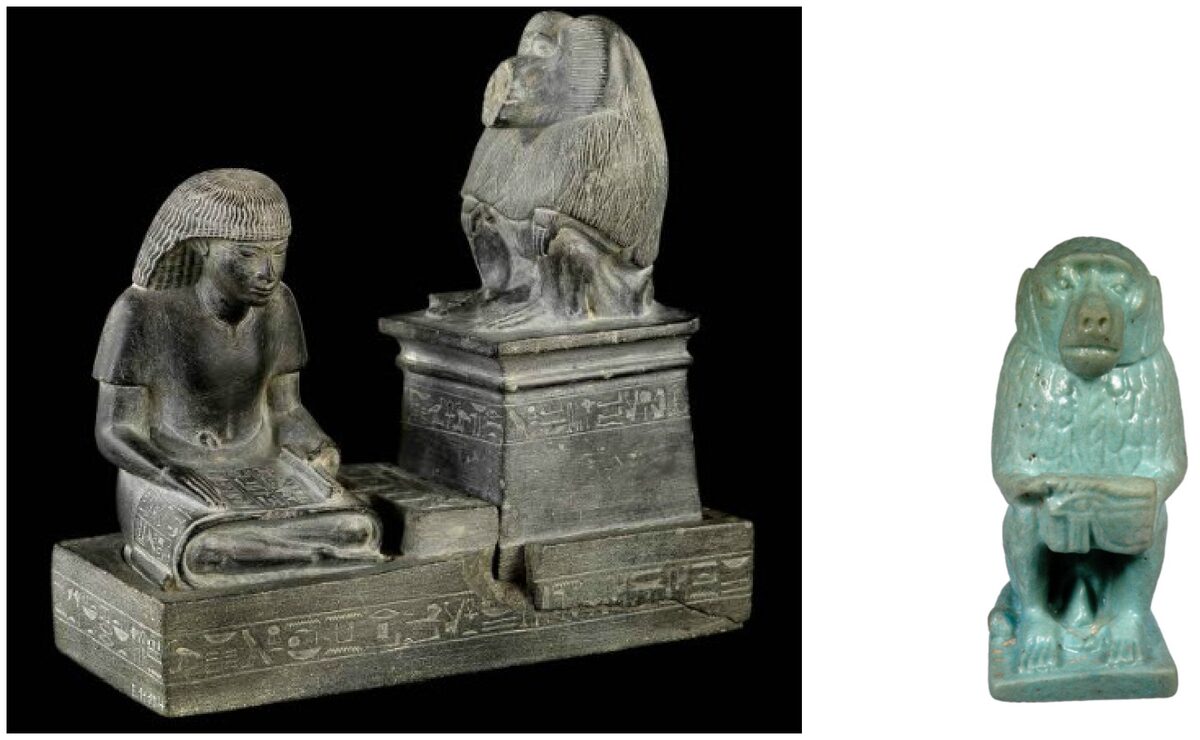
Royal scribe and Priest Lecturer-in-Chief Nebmerutef in greywacke L 20.5, New Kingdom, © 2015 Musée du Louvre/Christian Décamps; green glazed god Thoth as a squatting baboon presenting a wedjat H 4.1, undated, Eton College Museum #1718-2010
But not all baboons or monkeys are Thoth!
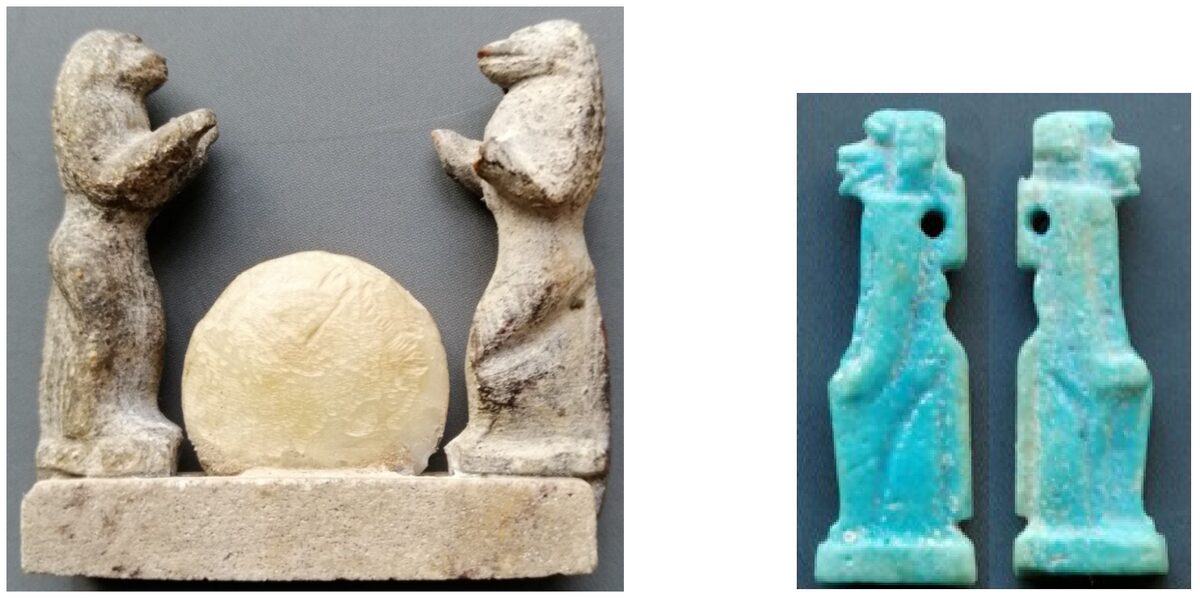
Stone baboons worshipping the rising sun in alabaster, all pushed into a stone rail H 4.5, Late Period; cercopithecus (pet or sex symbol), blue glaze H 3.7, Late Period. Private collection DA
And not even all squatting baboons are Thoth!
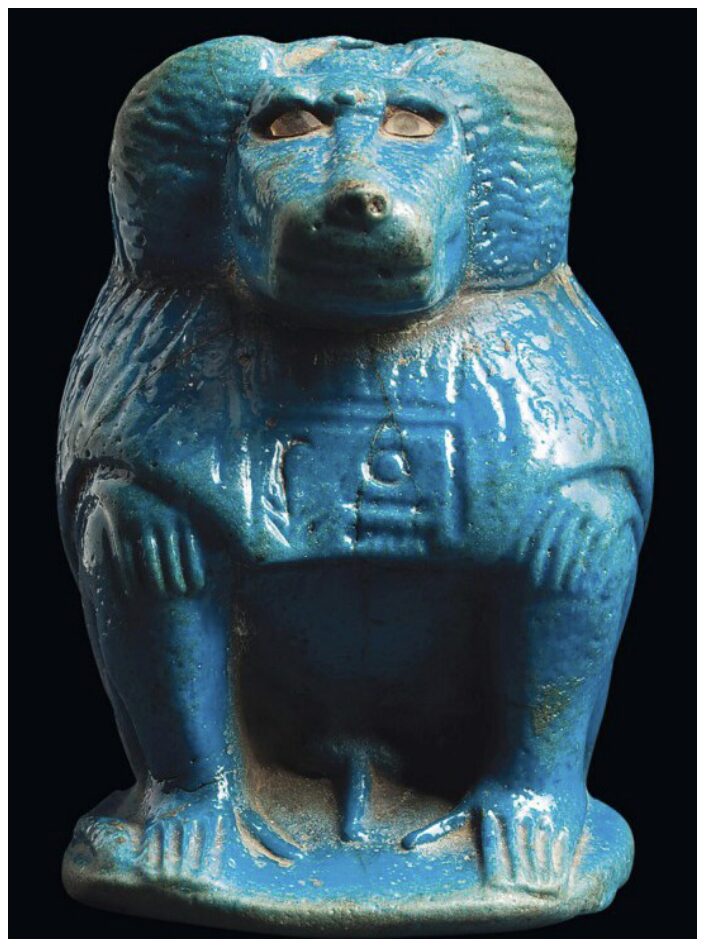
Blue glazed god Khonsu as a squatting baboon with coloured glass inlaid eyes, named on the pectoral. H 9.5, New Kingdom, Dynasty 19-20. Christie’s The Groppi collection, Sale 7758, lot 48, 26 April 2012
To determine periods, most people, experts included, rely on searching for parallels. This is fine, but very time-consuming. I am of course using this method, but I also propose a number of hitherto unpublished criteria below. By combining these criteria it is possible to limit the date range and achieve a fairly accurate approximation.
Means of suspension
Predynastic, Old Kingdom and First Intermediate Period: simple holes
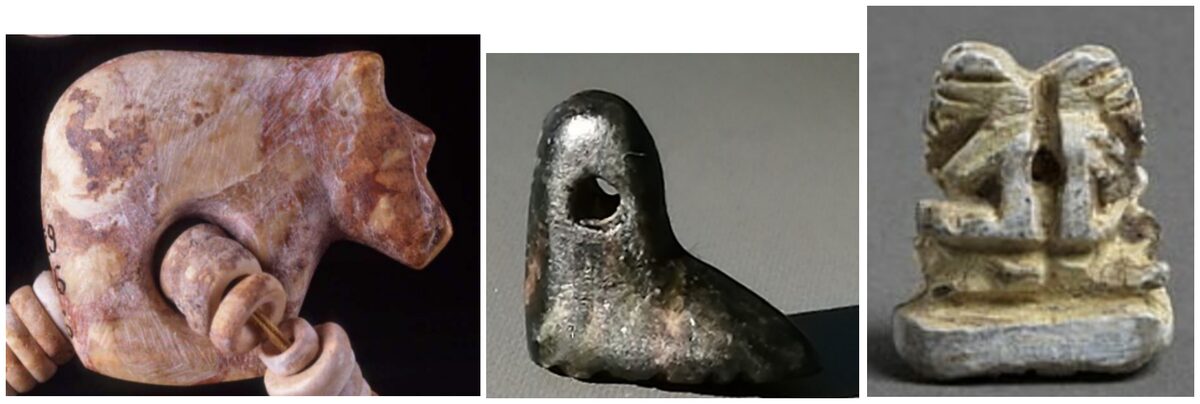
Hippopotamus H 2.0, Predynastic, Badarian Period, © The Trustees of the British Museum #EA59704; foot seal in serpentine? H 1.7, Old Kingdom, Dynasty 3-6, Private collection DA; women suckling children in glazed steatite H 2.0, First Intermediate Period, © 2018 Musée du Louvre/Philippe Fuzeau #NRFML.AE.2018.62.3
Middle Kingdom: simple holes, many pierced diagonally
In the Middle Kingdom, amulets have simple holes1, with many typically pierced diagonally.
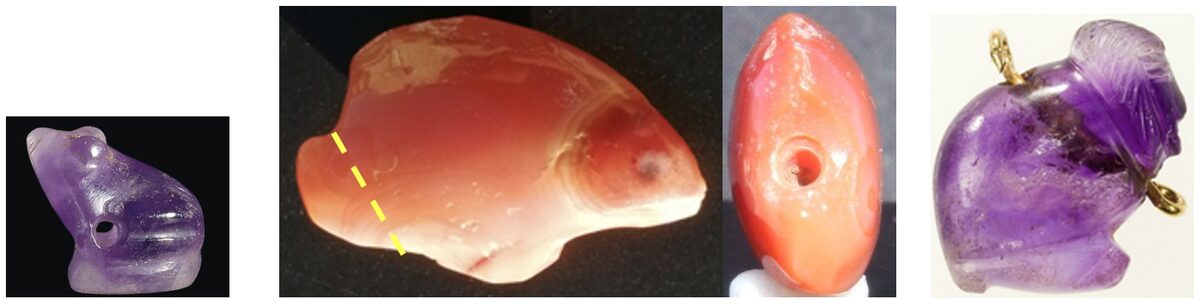
Amethyst frog H 1.0, Christie’s Sale 4925, part of lot 117, 26 April 2012; carnelian fish L 1.8, the broken yellow line denotes the suspension hole, Private collection DA; amethyst sphinx with traversing remnant of gold chain H 1.7, MET #2012.237.3
Note
1 A few amulets of the New Kingdom to the Roman Period also have simple holes
From the Middle Kingdom onwards: suspension loop
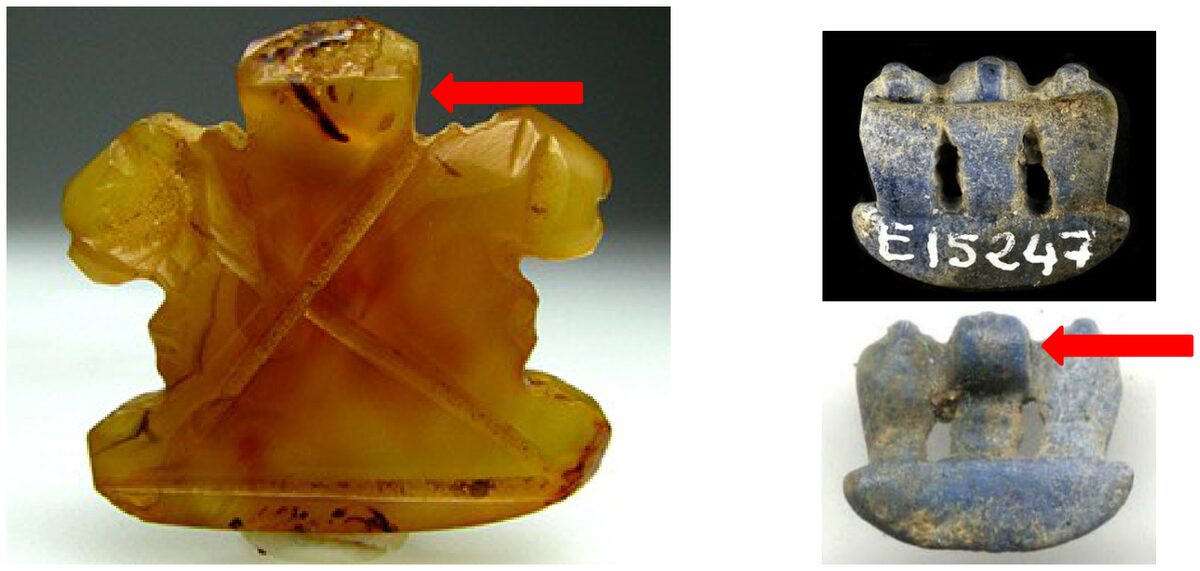
Carnelian god Aker L 2.1, Dynasty 11-12, Private collection DA; lapis lazuli three uraei on neb basket H 0.9, Dynasty 12, © 2015 Musée du Louvre/Antiquités égyptiennes #E 15247
Late Dynasty 18 to Dynasty 19: applied suspension loops
Applied suspension loops are found only from Late Dynasty 18 (reign of Amenhotep III and Amarna Period included) to Dynasty 19.
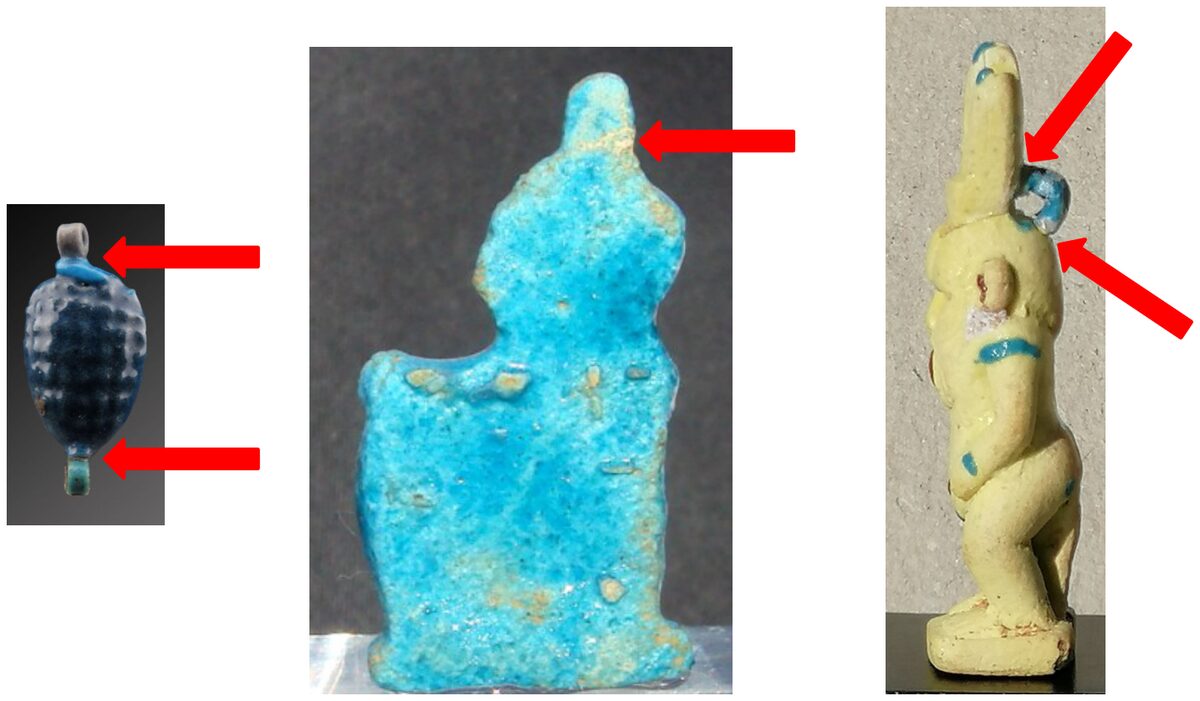
Violet, grey, blue, red and yellow glazes. Late Dynasty 18, Private collection DA
From the New Kingdom onwards: annealed suspension loops
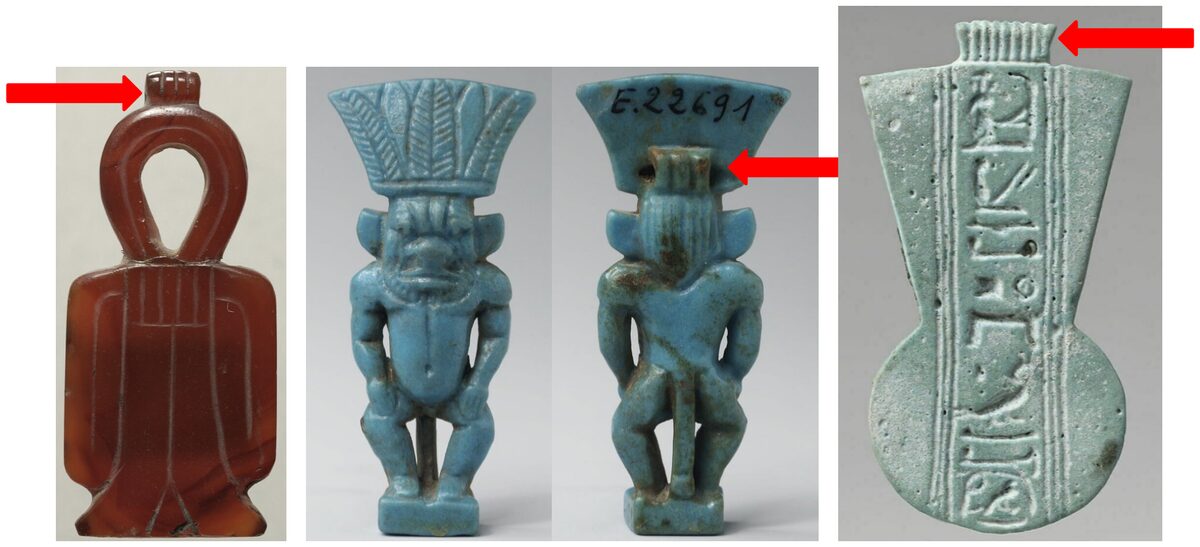
Carnelian Isis knot H 5.2, New Kingdom, © 2004 Musée du Louvre/Christian Décamps #E 1067; blue glazed god Bes H 5.2, Third Intermediate Period, © 2017 Musée du Louvre/Christian Décamps #E 22691; pale blue glazed menat counterpoise H 6.3, Late Period, Dynasty 26, © 2014 Musée du Louvre/Raphaël Chipault #N 4319 5
From the Third Intermediate Period: annealed loops or pierced dorsal pillar
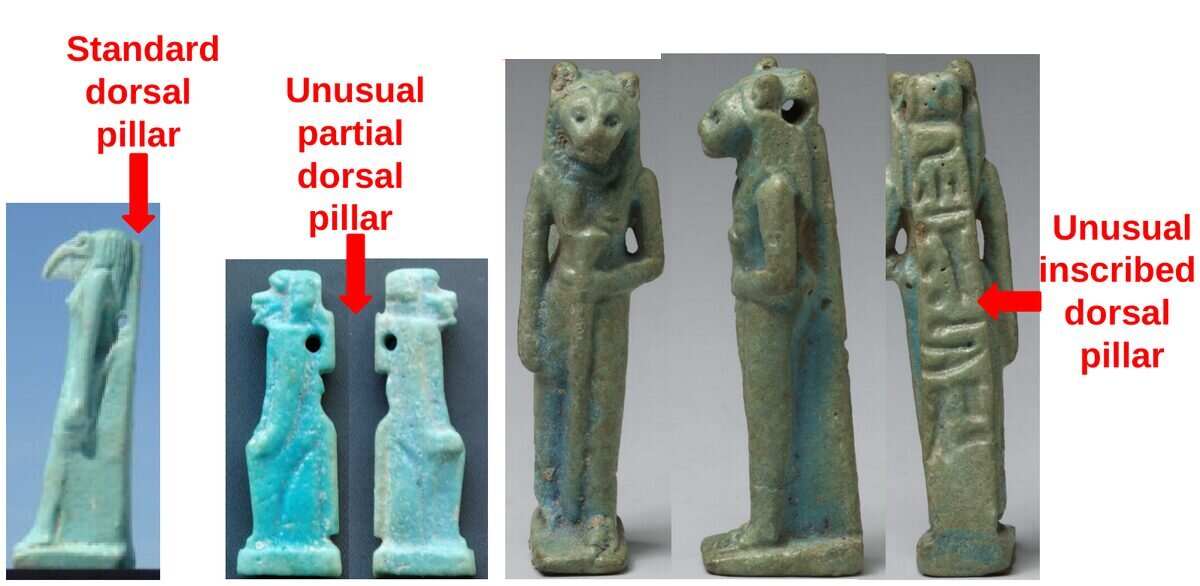
Standard dorsal pillar: blue glazed god Thoth H 4.5, Late Period, Private collection DA. Unusual partial dorsal pillar: blue glazed cercopithecus H 3.7, Late Period, Private collection DA. Unusual inscribed dorsal pillar: green glazed goddess Sekhmet H 6.6, Third Intermediate Period, © 2014 Musée du Louvre/Christian Décamps #AF 13550
Vertical piercing
Vertical piercing for suspension is rare. A Middle Kingdom attribution is realistic for the amethyst bird below, and it is documented for the New Kingdom Bes example.
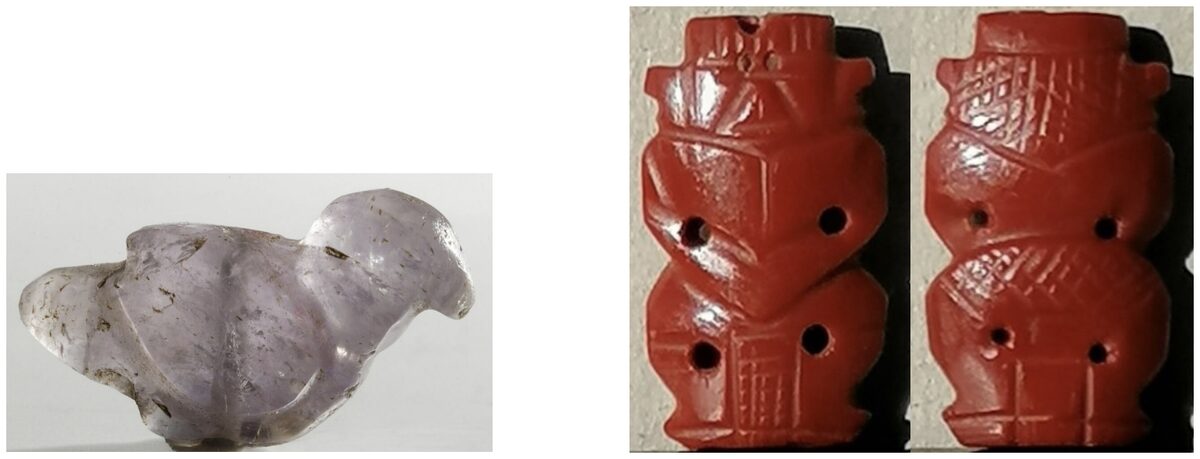
Amethyst bird H 1.5, Middle Kingdom, © 2002 Musée du Louvre/Christian Décamps #E 13724; red jasper god Bes H 2.7, New Kingdom, Dynasty 18, Private collection DA
Multiple suspension holes
Very rare New Kingdom amulets have multiple suspension holes. They were presumably collar pendants.
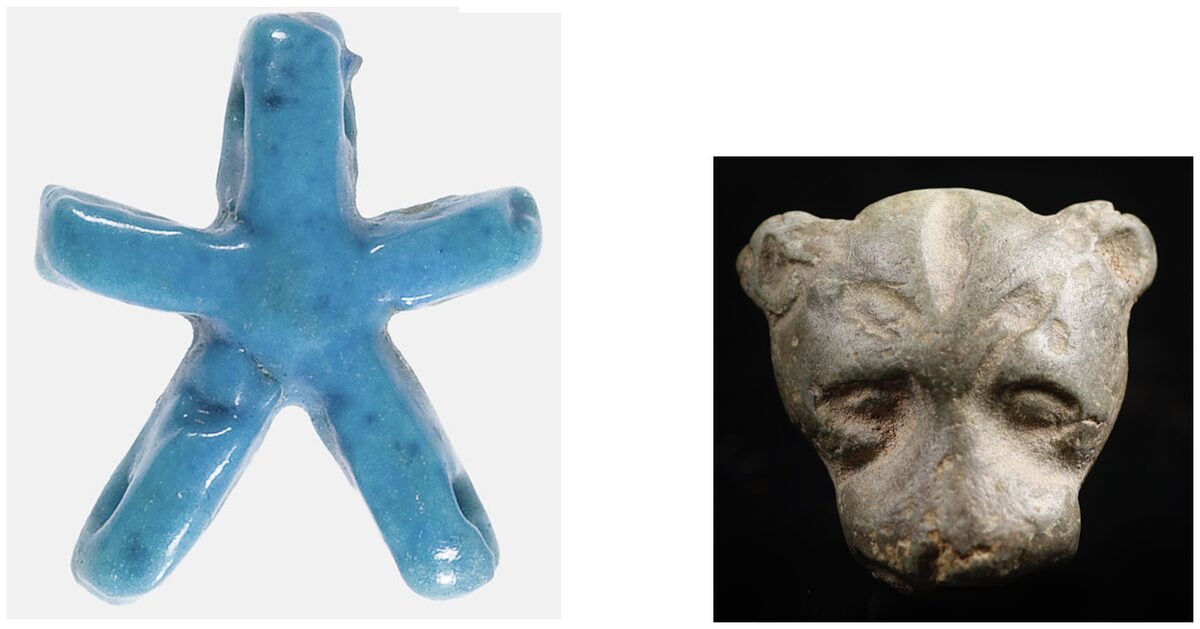
Blue glazed star pierced through the five branches H 1.7, New Kingdom, Dynasty 18, MET #11.215.201; green glazed leopard head with Y suspension holes (two on top fusing with one at bottom) H 1.3, presumably New Kingdom, Private collection DA
Material used and colour
Multicoloured glass amulets
They first occur in Late Dynasty 18 (reign of Amenhotep III). Peculiar spotted patterns are typical of the Amarna Period.
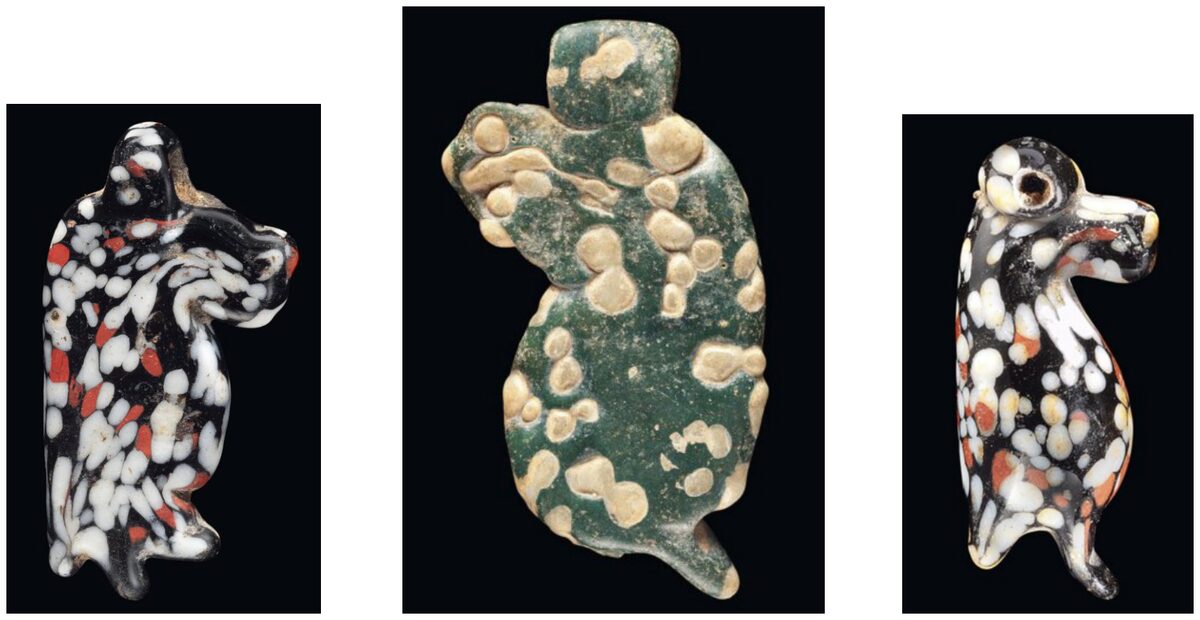
All standing Taweret goddesses: black, red and white glass H 2.4, lot 70; green and yellow glass H 3.4, lot 73; black, red, yellow and white glass H 2.3, part of lot 72. Christie’s The Groppi collection, Sale 7758, 26 April 2012
Cast glass amulets
They are typical of the Late Ptolemaic Period. These flat-back amulets were cast by pressing the glass into shallow open moulds. Many look ragged where the glass overflowed the edges of the mould (see the middle example below). First monochrome, they gradually became bi- or multicoloured during the middle and later Late Ptolemaic Period1.
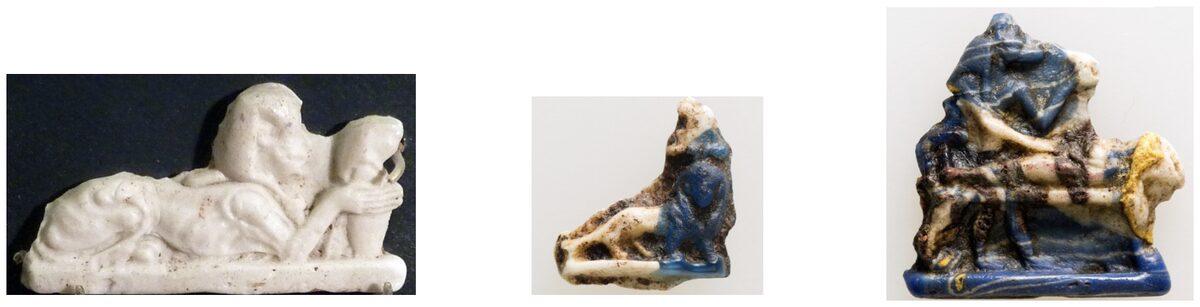
White glass sphinx holding a vase W 4.0, early Late Ptolemaic Period, © 2013 Musée du Louvre/Antiquités égyptiennes #E 2241; white and blue glass god Tutu W 1.7, middle Late Ptolemaic Period, MET #17.194.2517; blue/white/yellow/red glass god Anubis standing over a mummy W 2.6, later Late Ptolemaic Period, MET #17.194.2518
Reference
1 The distinctions between early, middle and later Late Ptolemaic Periods are made as indicated in the description of MET #17.194.2518
Iridescent glass amulets
They are typical of the Ptolemaic Period.
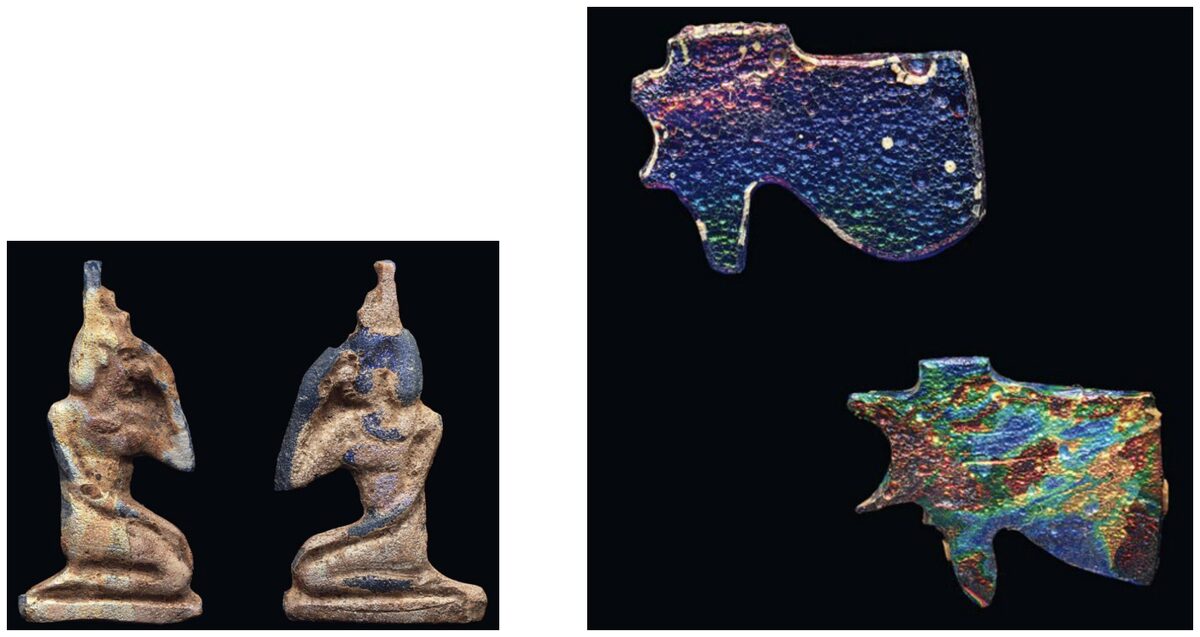
Two glass mourning Isis with faded blue and yellow iridescence H 3.8, Christie’s The Groppi collection, Sale 7758, lot 50, 26 April 2012; two glass wedjat eyes with gold, purple and green iridescence, maximum L 3.0, Christie’s The Groppi collection, Sale 7758, part of lot 58, 26 April 2012
Sheet gold and gilded amulets
Fine sheet gold amulets appeared in the First Intermediate Period and then disappeared. They were reintroduced in later periods, particularly in the Roman one. However, the Late Period ones are mostly of poor execution.
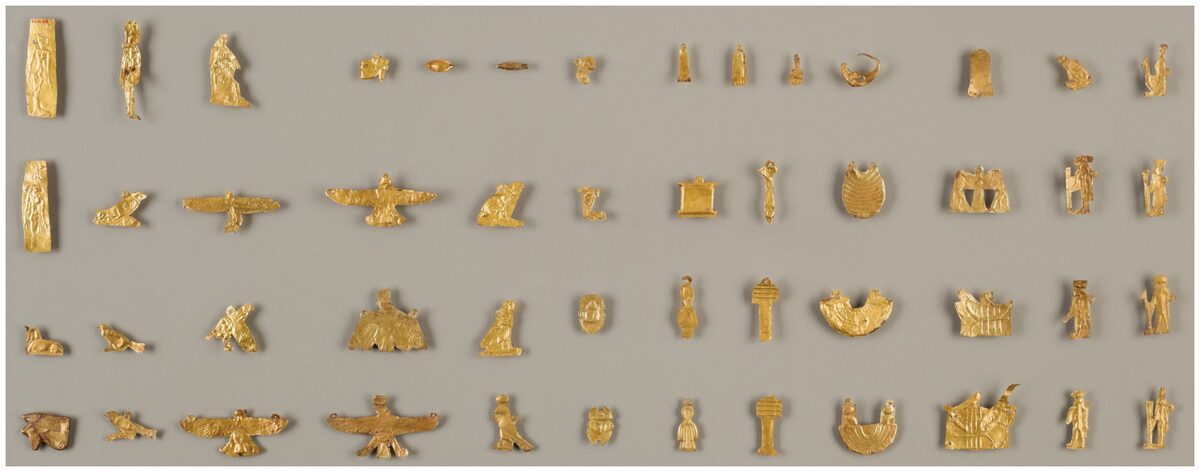
Collection of sheet gold amulets of the Late Period representing deities and symbols. The Metropolitan Museum of Art
Almost all gilded amulets in stone, copper alloy and wood were made in the Late Period.
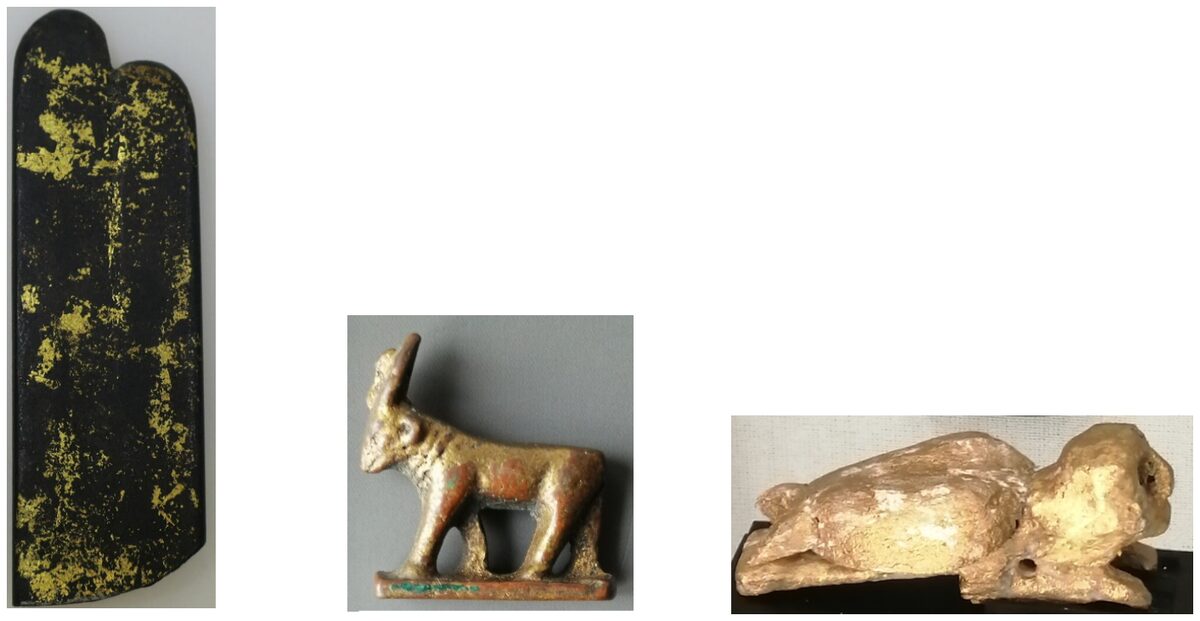
Gilded obsidian two fingers H 6.8, © Musée du Louvre/Antiquités égyptiennes #ME 207; gilded copper alloy Hathor cow L 3.2, Private collection DA; gilded wooden Ba bird L 6.6, Private collection DA
Unusual faience colours (Late Dynasty 18 to Dynasty 22-23)
Unusual colours of faience were used from Late Dynasty 18 to Dynasty 22-23. There are numerous faience collar pendants of Late Dynasty 18, as below1. All are flat-backed, often with two applied suspension loops at the top and bottom.
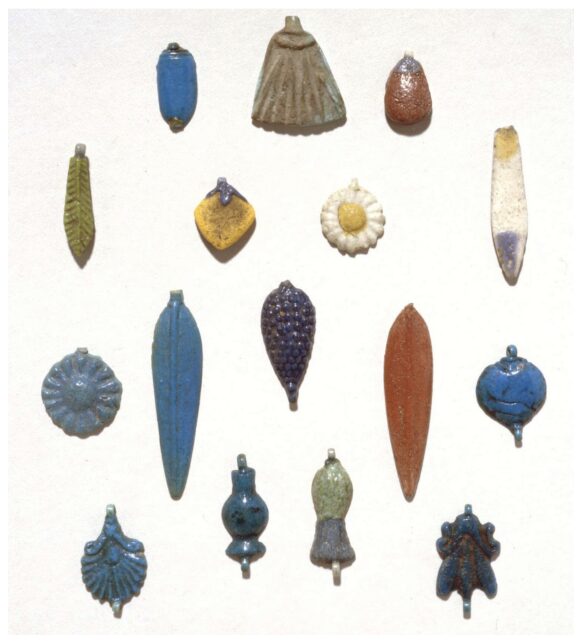
Faience collar pendants of Late Dynasty 18, H 2.0-5.0. © The Trustees of the British Museum. In: Andrews Fig. 65
Reference1 and Note2
1 Flowers, fruits and leaves as above have amuletic significance, see Andrews C. Amulets of Ancient Egypt, 1994, p. 80
2 I am suggesting that Akhenaten introduced these motifs to replace and get rid of amulets of animal and anthropomorphic deities: these peculiar glazed amulets did not exist before the Amarna Period and disappeared thereafter
Quality of production
Third Intermediate Period
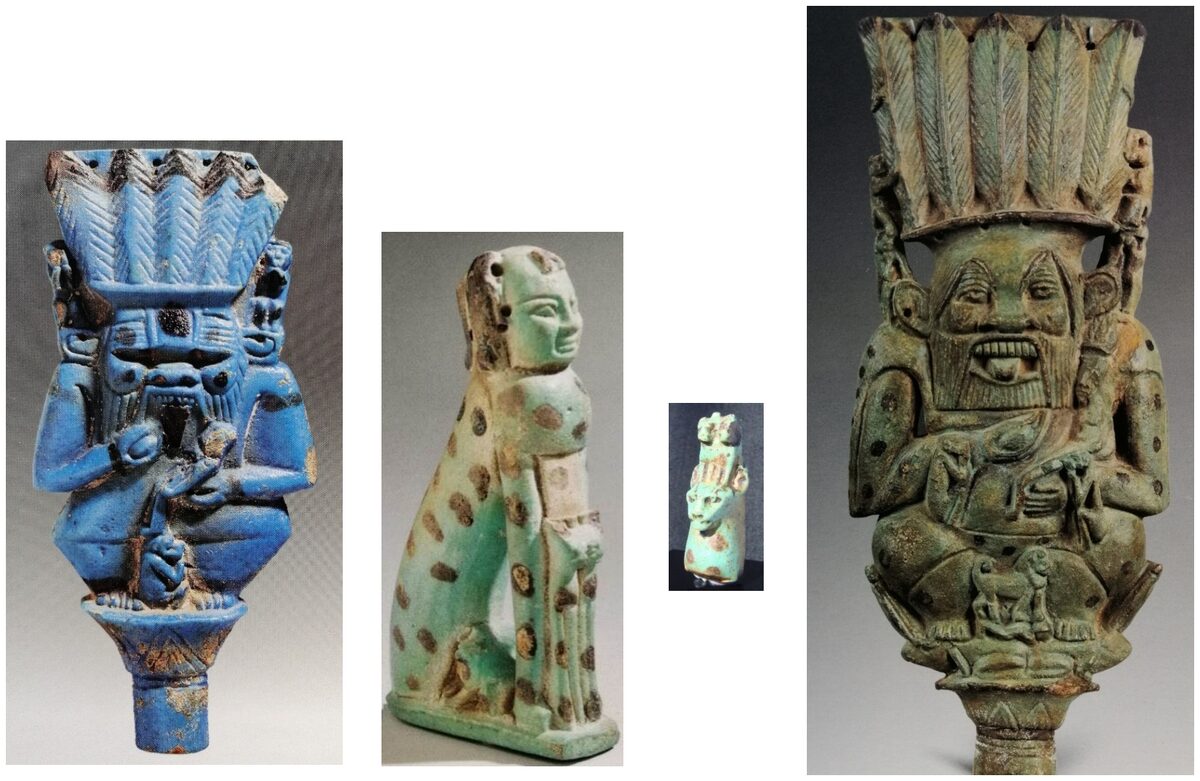
‘Amulets of happy maternity’ with dark spots H 3.9 to 28.0. Musée du Louvre, Musée d’Archéologie Méditerranéenne (Marseilles) and Private collection DA
Late Period, Saite Dynasty 26
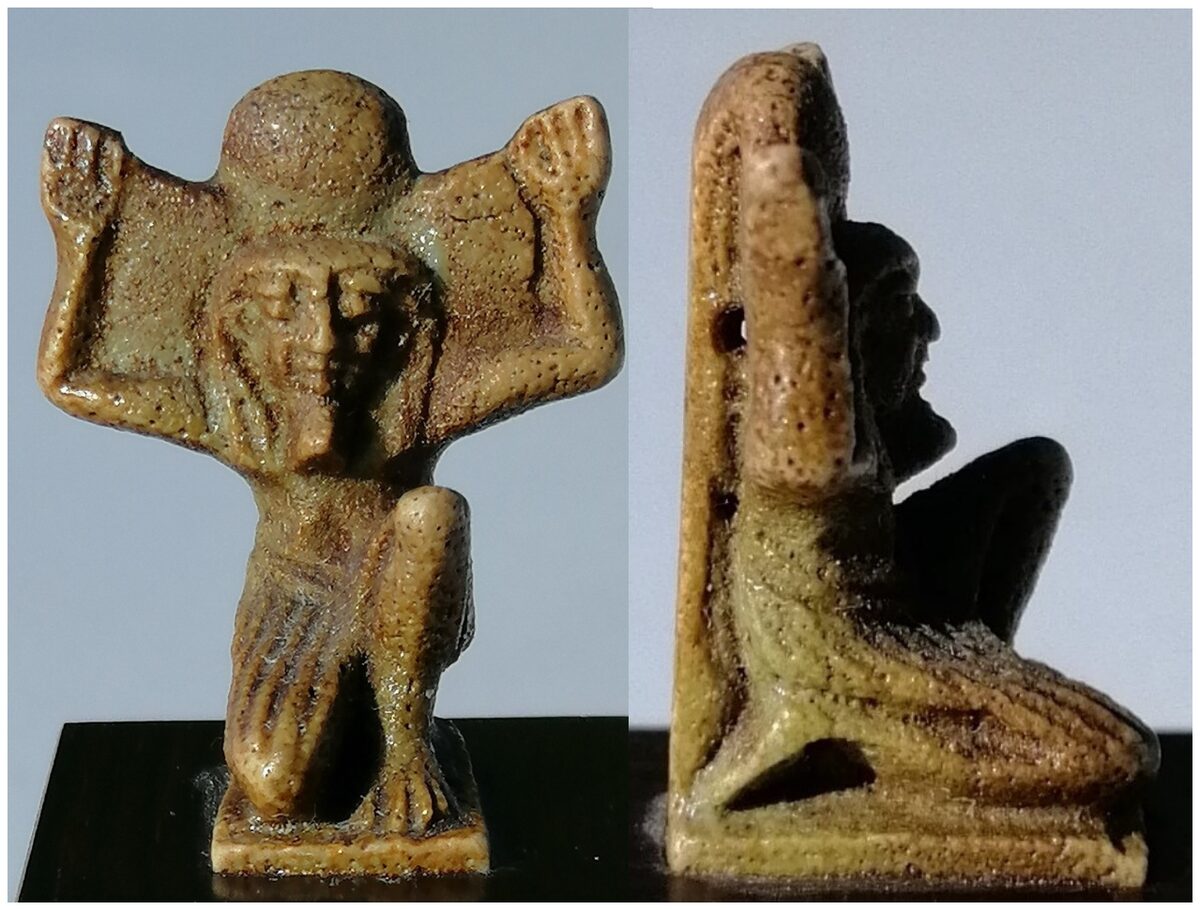
Brown/green glazed god Shu H 2.5. Private collection DA
Technique
Openwork amulets
They are typical of the Third Intermediate Period (Dynasty 21-25), although rare ones date from Late Dynasty 18, reign of Amenhotep III (see hieroglyphic amulets in Part 2).
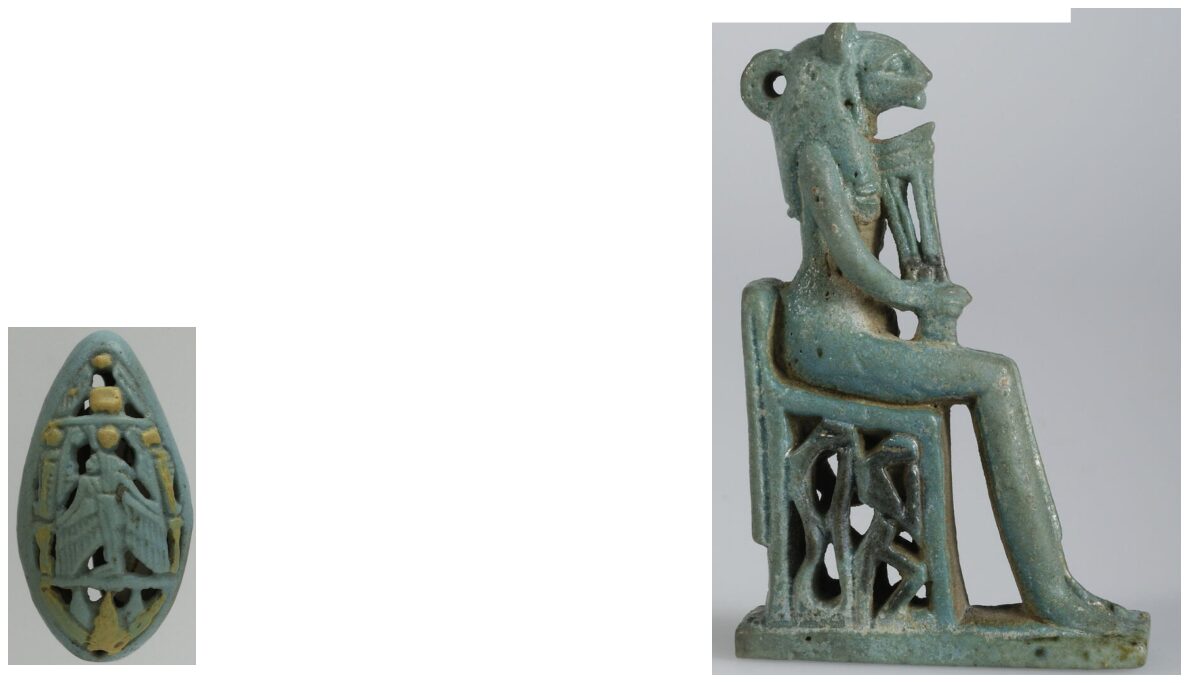
Blue and yellow glazed openwork cowroid H 3.2, © 2003 Musée du Louvre/Christian Décamps #E3589; blue glazed lioness-headed seated goddess H 6.2, © 2009 Musée du Louvre/Christian Décamps #N 3825 D
Glazed multicoloured amulets with coloured spots or encrustations
Amulets with coloured spots (not dark ones) or encrustations are typical of the New Kingdom.
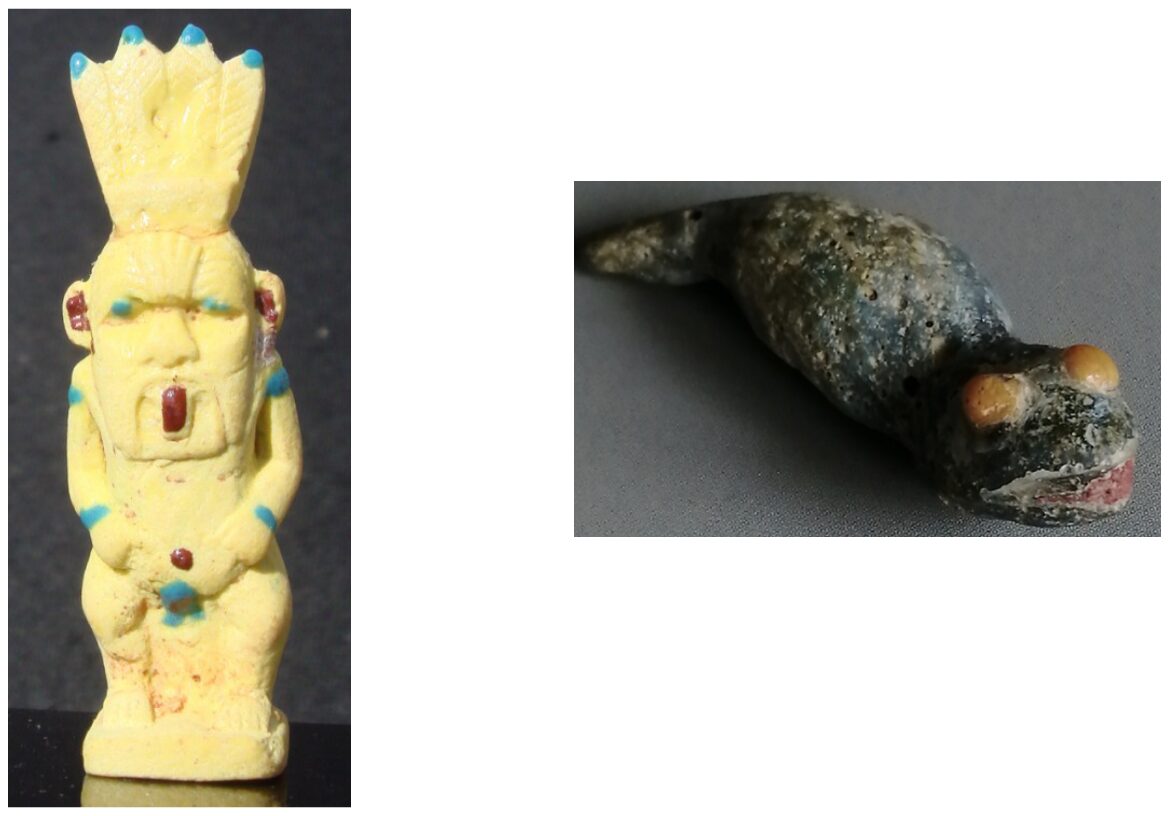
Yellow glazed god Bes with red spots on protruding tongue, ears and navel, and blue spots on the top of plumes, eyes, bracelets and sex H 3.7, Amarna Period; green glazed tadpole foundation deposit with encrusted orange eyes and red mouth L 2.0. Private collection DA
However, blue or green glazed amulets with dark spots are ‘Amulets of happy maternity’ of the Third Intermediate Period1 (see Quality of production above).
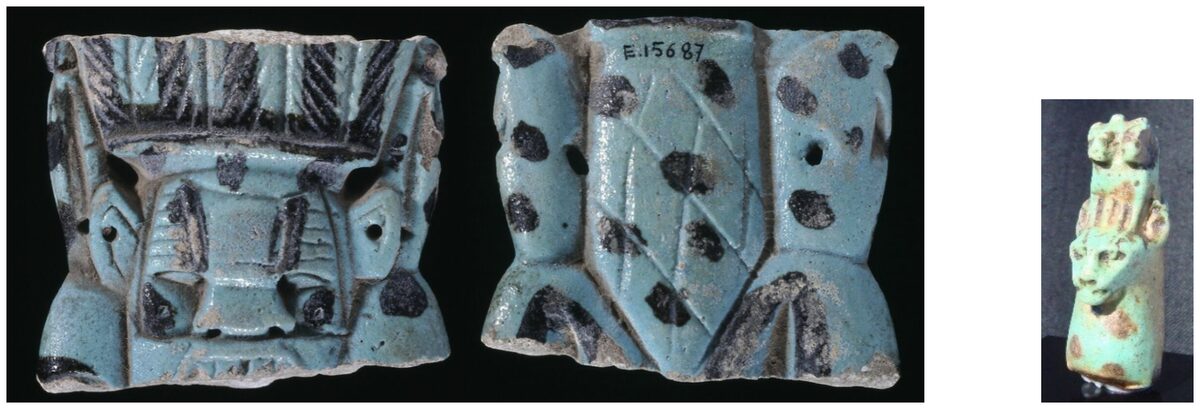
Broken blue glazed head of god Bes H 5.7, © 2005 Musée du Louvre/Georges Poncet #E 15687; broken green glazed cat head with two kittens overhead H 3.9, Private collection DA
Reference
1 Bulté J. Talismans Egyptiens d’heureuse maternité «Faïence bleu-vert à pois foncés». 136 pp. with 32 additional plates, 2005. CNRS Editions
Blue or green/yellow coloured amulets
They are typical of the Roman Period.
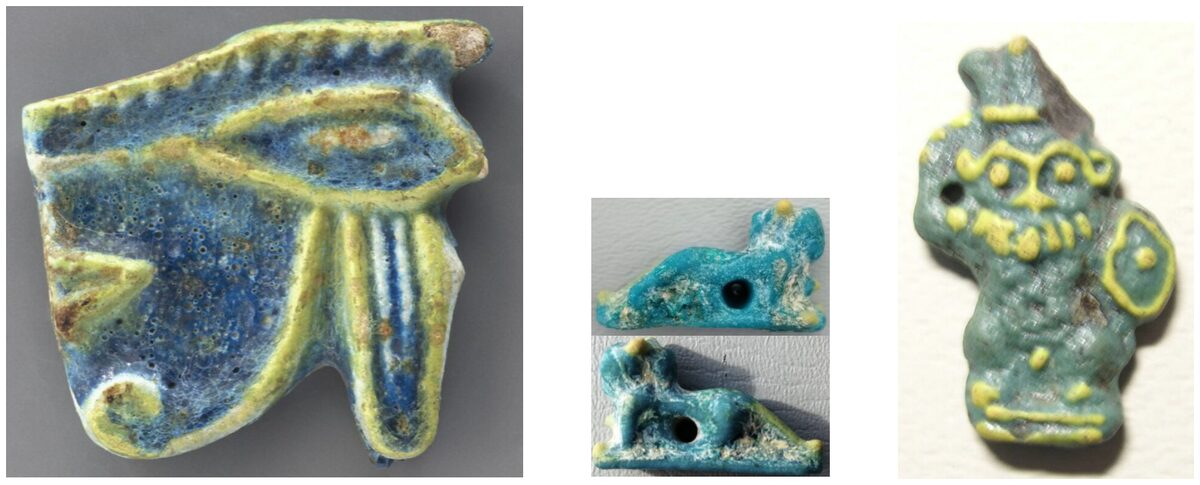
Blue/yellow glazed wedjat H 4.3, W 4.6, T 1.0, © 2004 Musée du Louvre/Georges Poncet #E11285; turquoise/green-yellow glazed god Tutu L 2.1, H 1.3, W 0.4, Private collection DA; green/yellow glazed Bes as a Roman soldier H 4.2, W 2.7, D 0.8, © 2013 Musée du Louvre/Antiquités égyptiennes #E 14193
Help for the dating of amulets
The chart below summarises, for each period, which of the criteria described above are common or uncommon.
Abbreviations: PDT Proto or Predynastic, Thinite; OK Old Kingdom; FIP First Intermediate Period; MK Middle Kingdom; SIP Second Intermediate Period; NK New Kingdom; TIP Third Intermediate Period; LP Late Period; PT Ptolemaic; RO Roman.
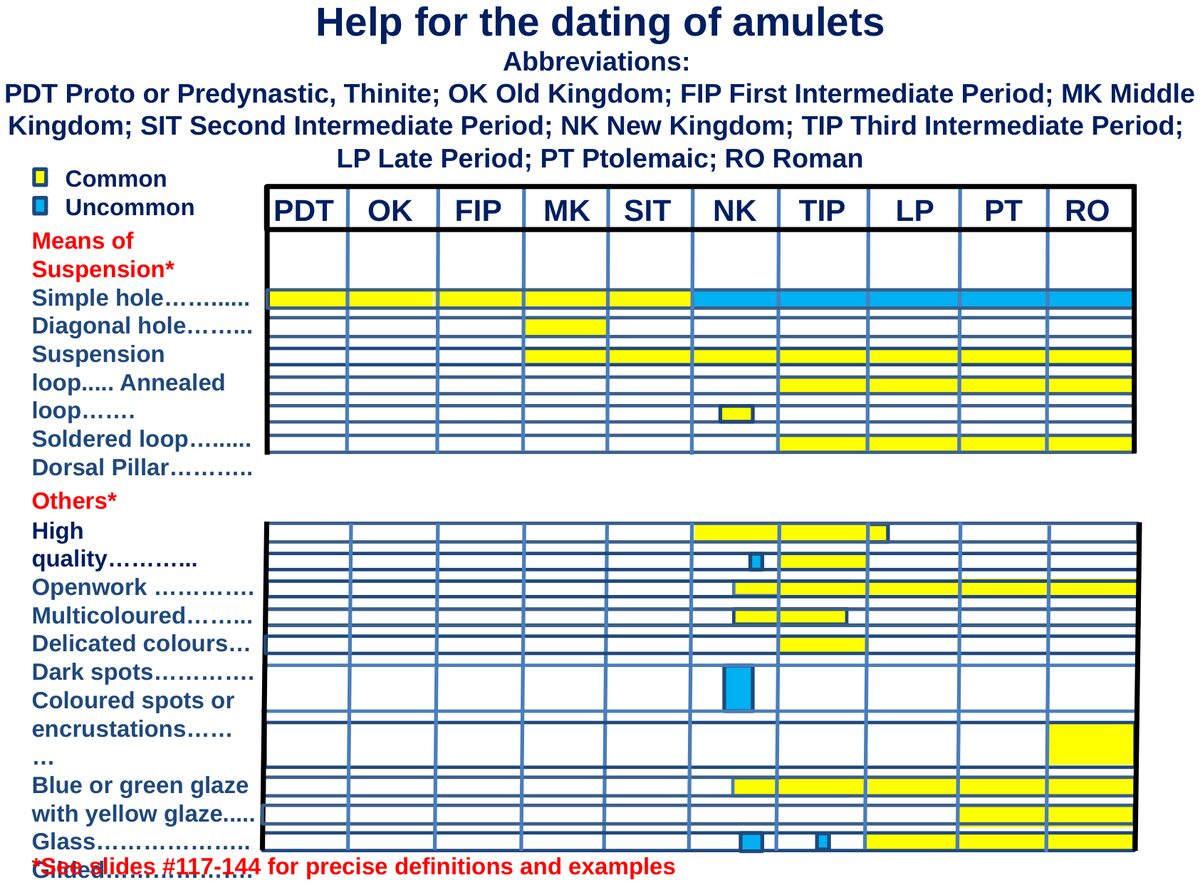
Chart: means of suspension and other criteria (quality, openwork, multicoloured, delicate colours, dark spots, coloured spots or encrustations, blue or green with yellow glaze, glass, gilded), common or uncommon in each period. Click to enlarge
I routinely use all the criteria described on this page to assign an approximate period to every amulet of my collection, in addition to searches for parallels. However, helpful as this is, it is NOT a golden rule, as shown below.
Materials used and periods
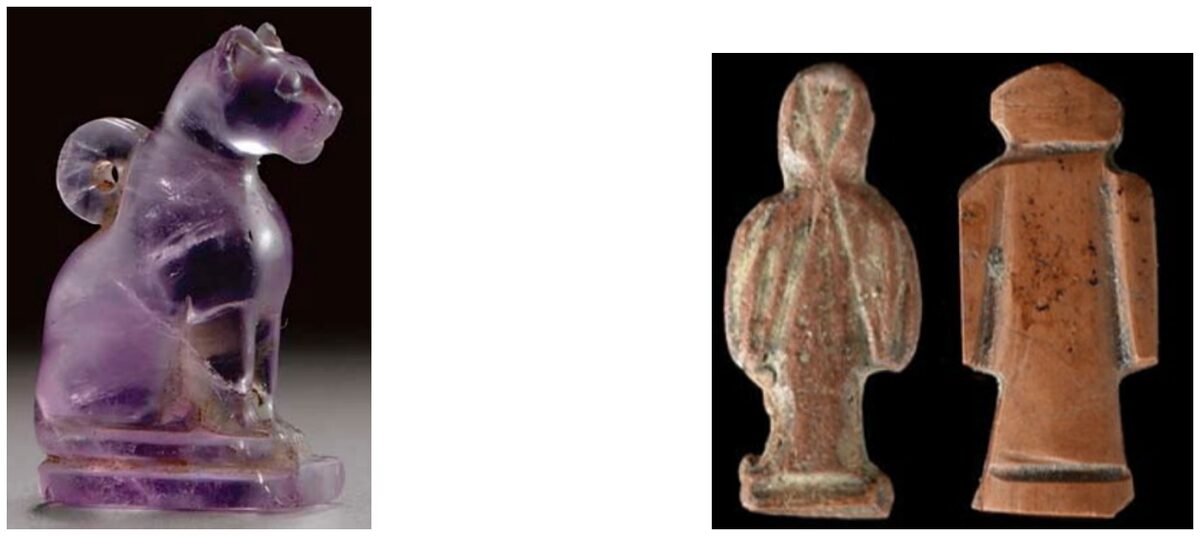
Amethyst goddess Bastet H 2.5, Late Period to Ptolemaic Period1, Christie’s Antiquities Sale 1846, lot 35, 8 June 2007; two red jasper Isis knots H 2.2, Ptolemaic Period-Roman Period2, © 2007 Musée du Louvre/Georges Poncet #AF 7944
References
1 Most amethyst amulets were made in the Middle Kingdom, but amulets of Bastet date from Dynasty 18 to the Late Period
2 Red jasper is typical of the New Kingdom (see description of MET #10.130.2429), but these two amulets were found on Elephantine island in well-dated contexts
Passing fads
Some amulets occur throughout all dynastic times (falcons, scarabs, wedjat eyes, etc.). Others were only produced during more or less short periods of time, or appeared for religious reasons.
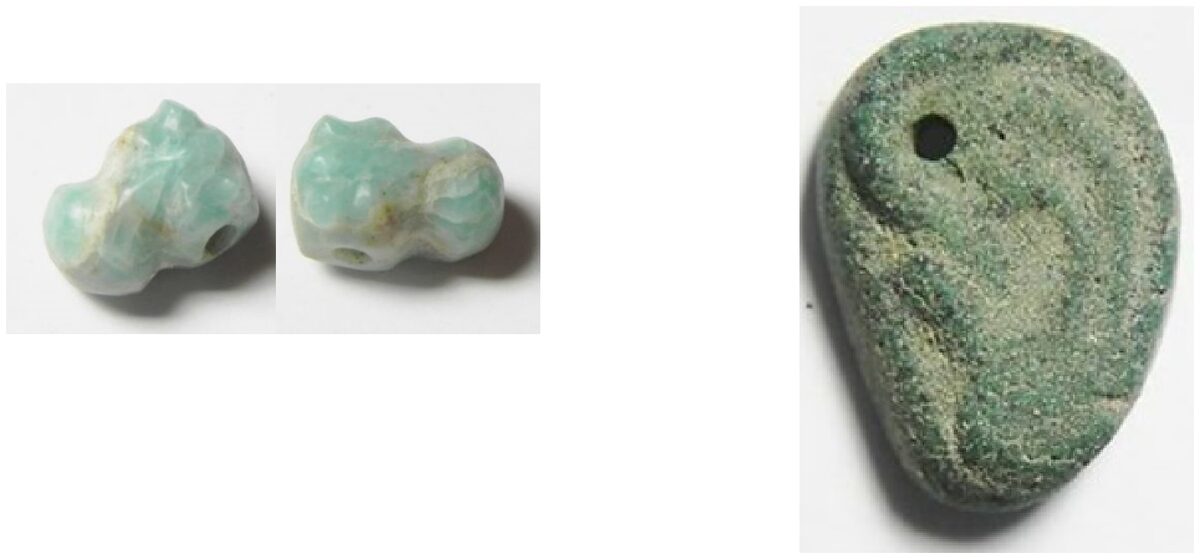
Feldspar head of hippopotamus L 0.8, only in the Middle Kingdom, protects against the animal’s dangerousness; green glazed flat-back ear H 2.4, New Kingdom, only in Dynasty 18, enables hearing. Private collection DA
Amulets of Montu, a war god who first appeared in the Middle Kingdom, are rare. Montu is a falcon or therianthropic (human falcon-headed or human bull-headed). His cult only gained some importance from the New Kingdom onwards.
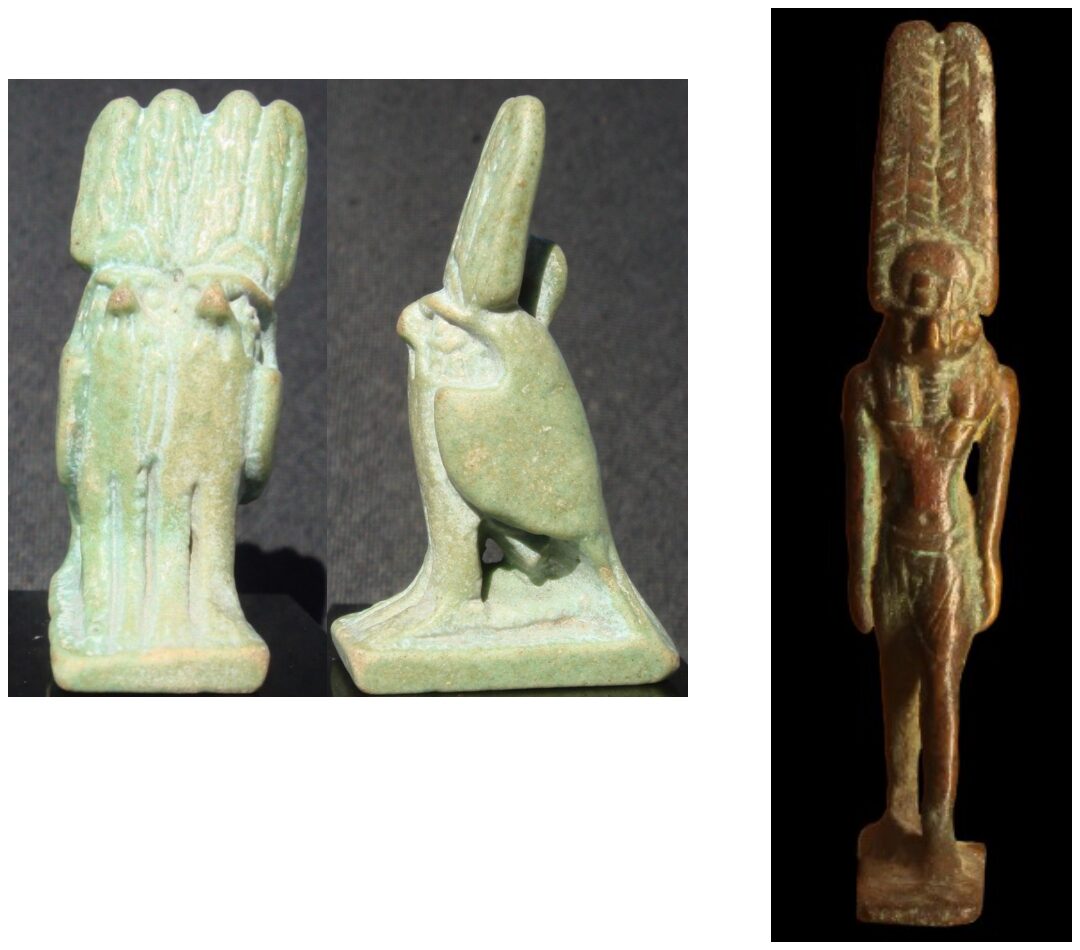
Green glazed double Montu H 3.6, Third Intermediate Period, Private collection DA; copper alloy falcon-headed striding Montu approximate H 6.0, Late Period, Musée des Beaux-Arts de Lyon, © Photograph D. Attaix